Nvidia's Flora Cuts Robot Video Labeling Costs by 125x — But There's a Catch
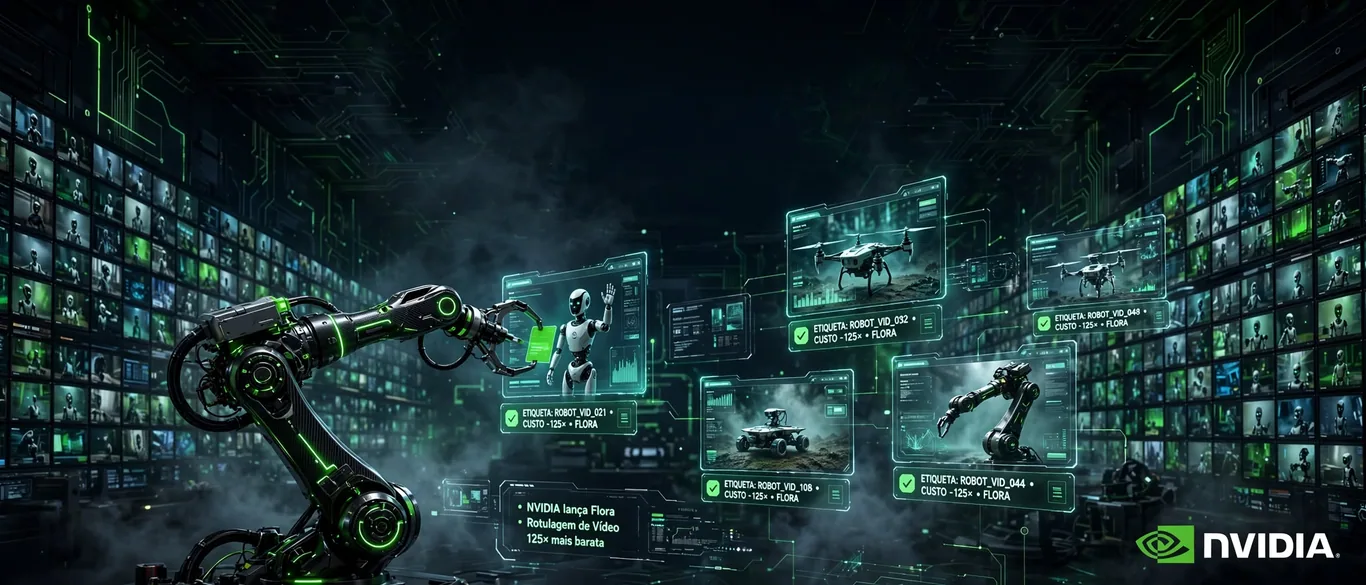
Training robots requires massive amounts of video data annotated with action descriptions, step-by-step progress ratings, and task success judgments. Commercial frontier models can handle these tasks, but the computing bills quickly become unsustainable for teams trying to scale robotics datasets.
How does Nvidia Flora change video labeling costs?
According to research from Nvidia's GEAR lab, Flora processes one hour of robot video for about 72 cents. By comparison, using GPT-6 Astra for the same workload runs roughly $88.50 per hour, while Claude Opus 5 sits around $42. This price difference stems from Flora's architecture, which relies on three fine-tuned Qwen3.5 models running locally rather than invoking massive commercial APIs.
However, the 125x cost reduction comes with important caveats. Nvidia's financial figures are projections based on an estimated GPU rental price of $10 per hour, rather than live production measurements. Furthermore, while Flora dominates in temporal localization and catching mid-episode errors, it occasionally mislabels specific actions, such as describing a plate-wiping motion as folding a napkin.
How funciona na prática
Flora splits the annotation workload across three specialized open-source models available on Hugging Face:
- Segmentation Model (9B): Breaks raw video feeds down into distinct action segments based on time stamps.
- Captioning Model (27B): Generates descriptive text for each action while factoring in context from preceding and succeeding frames.
- Flora-Rewarder (27B): Evaluates episode success on a 1-to-5 scale, grades each half-second step as normal, suboptimal, or failed, and applies rubric-based scoring.
Vale a pena para a sua rotina?
If you are building custom robotics models or managing large-scale computer vision pipelines, Flora offers an unmatched open alternative to commercial offerings like Scale AI's data engines. It catches over 50 percent of failed steps within an episode, outperforming competitors that struggle to flag partial task failures. For everyday software developers who do not work with physical AI hardware or heavy video datasets, however, the tool offers little direct utility.
Sources
Frequently asked questions
- What is Nvidia Flora?
- Flora is an open-source data engine built by Nvidia on top of fine-tuned Qwen3.5 models to automate the labeling, segmentation, and reward scoring of robot training videos.
- How much does it cost to use Flora?
- Nvidia estimates the annotation cost at roughly 72 cents per hour of video, based on projected GPU rental prices of $10 per hour, compared to $88.50 with GPT-6 Astra.
- Where can developers access Flora?
- The underlying models and components of Flora are available for download on Hugging Face for teams building robotics datasets.
Comments
0 commentsDeixe seu comentário
Be the first to comment.
Continue Reading

Meta Quietly Fixed AI Chat Clutter: What Are Muse Spaces?
Meta introduces custom spaces for Muse agents

Perplexity's $200 AI Agents: Are They Worth the Premium?
Perplexity launches always-on workplace AI agents

Can OpenAI's GPT-6 Cyber Finally Stop AI From Hacking Random Networks?
OpenAI launches GPT-6 Cyber with fewer rogue exploits