Why Spotify Is Welcoming AI Agents While Amazon Blocks Them
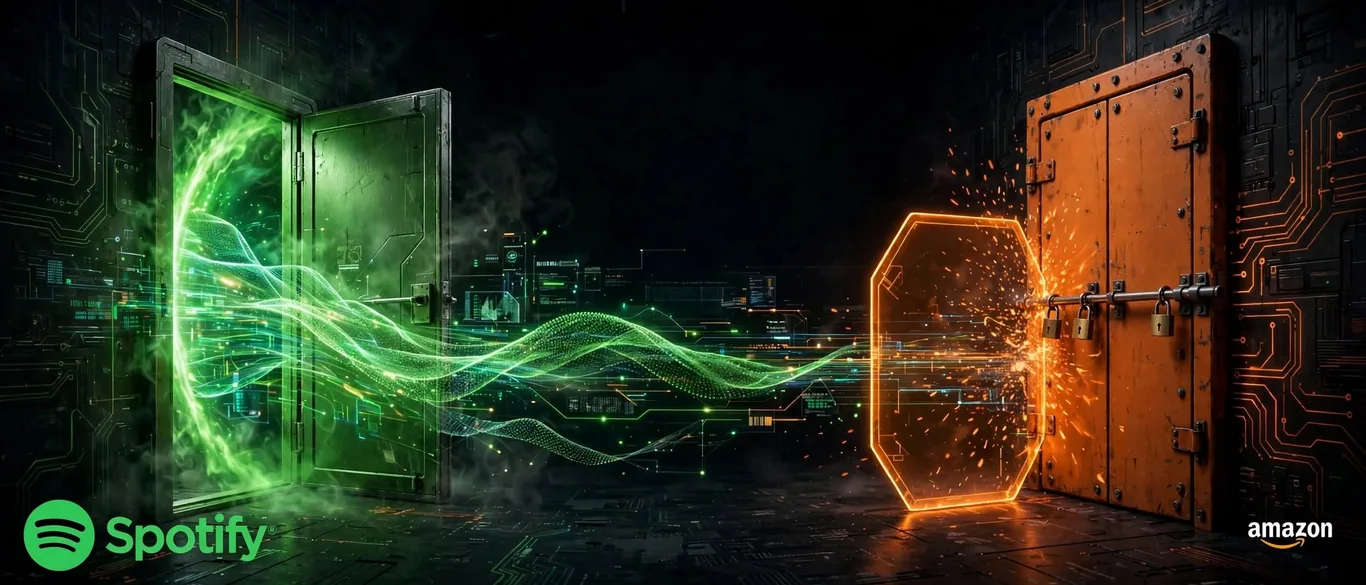
As artificial intelligence agents take over routine chores, tech companies are fiercely debating whether to welcome these bots or lock them out. While platforms like Amazon are actively blocking external assistants from handling purchases, according to TechCrunch, the Spotify streaming service is taking the exact opposite approach by aggressively integrating into third-party AI ecosystems.
During a recent earnings call reported by TechCrunch, Spotify co-CEO Gustav Söderström explained that entertainment differs fundamentally from productivity tasks. While users want to eliminate tedious chores entirely, nobody asks an AI to summarize a favorite song. Instead of forcing users to open a dedicated app to search for artists and build manual playlists, Spotify wants to be the underlying audio provider called whenever an assistant handles a request.
How the strategy works behind the scenes
Spotify has already integrated directly into conversational interfaces such as Meta’s Muse assistant, OpenAI's ChatGPT, and Anthropic's Claude. Rather than losing control of its audience, the company uses these integrations as a growth tailwind by letting users interact through natural conversation.
Crucially, privacy remains a central pillar of this architecture. As Söderström emphasized to TechCrunch, Spotify does not hand over sensitive listener data or history to external tech partners. Instead, the external agent sends a structured request, and Spotify's internal systems process the command securely to determine what music or podcast to play.
Is this a winning move for digital workflows?
For professionals building or using agentic workflows, this pivot highlights a vital shift in software design. As users increasingly rely on unified assistants for daily operations, services that refuse to interoperate risk becoming invisible. Spotify's willingness to act as an accessible backend service ensures it remains relevant regardless of which front-end interface a user prefers.
The core takeaway for product builders is clear: thriving in the agentic era requires designing systems with native API access that other intelligent agents can easily invoke. By treating AI assistants as valuable distribution channels rather than competitive threats, Spotify is securing its footprint in the next generation of digital consumption.
Sources
Frequently asked questions
- Why is Spotify integrating with AI agents?
- According to TechCrunch, Spotify wants to be the default audio service that AI assistants turn to when users request music, podcasts, or audiobooks through conversational interfaces.
- Does Spotify share user data with AI partners?
- No. TechCrunch notes that external agents send requests to Spotify, but Spotify's own systems handle the data privately without exposing personal listening histories to partners.
- Which AI assistants currently integrate with Spotify?
- Spotify has integrated with Meta’s Muse assistant, OpenAI's ChatGPT, and Anthropic's Claude, according to TechCrunch reports.
Comments
0 commentsDeixe seu comentário
Be the first to comment.
Continue Reading

How Anthropic Used AI to Double Its Own Development Speed
Anthropic AI development speed doubles with automation
Tencent's Hy4: A Power User Tool or Just Another AI Mirage?
Tencent launches Hy4 with computer use

ChatGPT Hit 20% of Google's Search Volume — What Changes Now?
ChatGPT reaches 20% of Google search volume