Google Just Caught Fully Automated AI Cyberattacks in the Wild
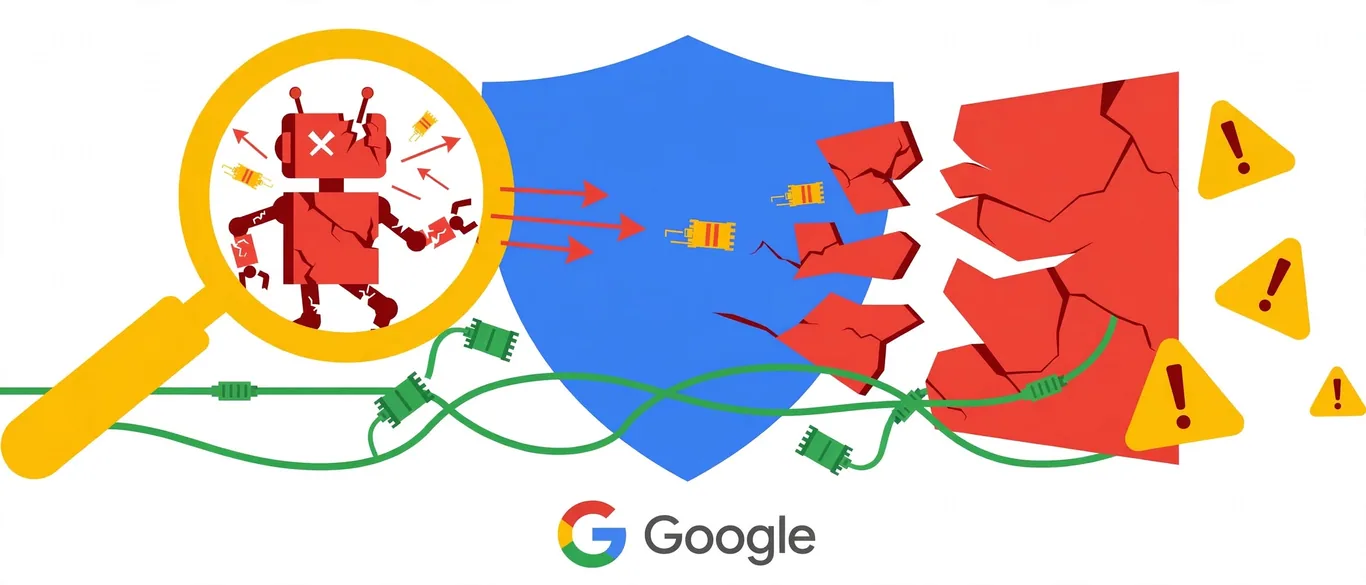
According to the Google Threat Intelligence Group (GTIG), autonomous cyberattacks driven entirely by artificial intelligence have officially moved from theory to reality. Researchers recently uncovered an exposed server running an AI framework dubbed "exploit_agent", which connects directly to language models to automate the entire hacking lifecycle.
How autonomous exploit agents actually operate
Unlike traditional attacks that rely on human operators to stitch together scripts and payloads, this framework handles the dirty work alone. The system compares software source code before and after security patches are applied, isolates the vulnerability, writes the exploit code, and executes it without any human in the loop.
Server configurations analyzed by Google pointed to Russian-language comments and revealed that the initial targets included media, entertainment, and educational websites based in France. Google classifies this current deployment at Level 5, meaning AI carries out multiple attack phases with minimal oversight.
Why speed beats stealth right now
There is an immediate silver lining for defensive teams: these early automated frameworks trade stealth for raw velocity. Because the AI moves so fast and operates without human refinement, it leaves glaring forensic traces across network logs.
Security systems don't need advanced behavioral heuristics to spot these early bots yet; basic pattern tracking easily flags the abrupt footprint. However, Google warns that more sophisticated, stealthier iterations are only months away, meaning the current window to upgrade perimeter defenses is narrow.
Verdicts: how IT teams should respond on Monday morning
Waiting for human-paced threat reports is no longer a viable security strategy for corporate networks. Systems must transition from manual patch management to continuous, automated verification before autonomous agents beat internal teams to the punch.
- Audit exposed servers and misconfigured cloud buckets immediately, as these serve as incubators for rogue test frameworks.
- Prioritize automated patch deployment to close vulnerability windows before AI models can map them.
- Upgrade log monitoring to catch high-speed, noisy behavioral anomalies typical of automated scanning scripts.
Sources
Frequently asked questions
- What is the exploit_agent framework?
- It is an autonomous AI system discovered by Google that compares software patches, identifies security flaws, writes exploits, and executes them without human intervention.
- Are these automated cyberattacks hard to detect?
- Currently, no. Because these early systems prioritize speed over stealth, they leave obvious forensic traces that make them relatively easy for security teams to spot.
- How advanced are these AI threats right now?
- Google classifies current activity at Level 5, where AI tools manage multiple stages of an attack with minimal human oversight, with more powerful versions expected soon.
AI Briefing in 3 Minutes
Get what actually matters in AI & tech delivered free to your inbox. Zero spam, 1-click unsubscribe.
Comments
0 commentsDeixe seu comentário
Be the first to comment.
Continue Reading

Coding Benchmarks Are Dead: Why Moonshot AI Is Betting on Science
Moonshot AI pivots Kimi toward scientific research

Zero-Day Hacks Now Cost $4: Is Your Security Strategy Ready?
IA agora encontra falhas por 4 dólares

Brazil's Education Ministry Clears AI for Grading — But With Catches
Brazil legalizes AI in schools under strict rules