Nvidia and Meta's New Open Models Demand Heavy Hardware
Open-weight artificial intelligence is surging in the US, challenging foreign dominance. However, according to The Decoder and ZDNET, running these powerful systems locally comes with steep hardware prerequisites that shift the financial burden from API fees to physical infrastructure.
What do these new open models actually change?
Nvidia's Nemotron 3.5 Super VL packs 120 billion parameters into a multimodal enterprise agent. It delivers task completion up to five times faster than competing open models. Meanwhile, Meta launched Muse Spark Open with 816 billion parameters, optimizing it for Apple's M5 Ultra chip.
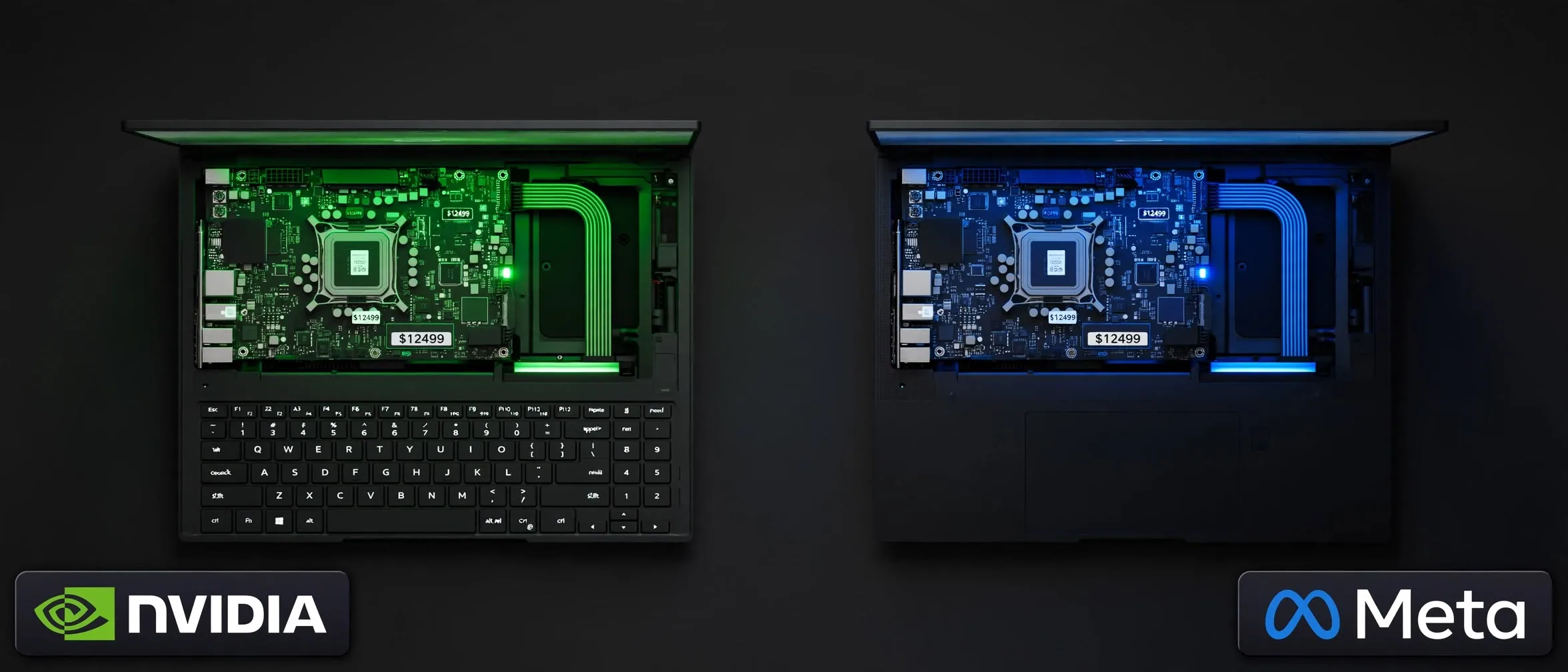
Despite the open-weight label, hardware demands remain unforgiving. Nvidia's local variant, the Bolt 74B-A9B, requires at least 24 GB of VRAM to function. This effectively prices out standard consumer computers, restricting local execution to enterprise workstations and high-end rigs.
How to run and test these new tools
Deploying these models in your workflow depends heavily on your available infrastructure:
- For cloud infrastructure: Access Nvidia's Super VL weights via Hugging Face and deploy them using the Dynamo inference engine to leverage KV-caching and cut initial response times.
- For local workstations: Use the Nemotron Bolt 74B model with tools like Ollama or llama.cpp, provided your machine meets the 24 GB memory minimum.
- For image generation: Download Black Forest Labs' FLUX 3 Image Klein, which runs on consumer GPUs with 8 GB of VRAM using an INT8 build via ComfyUI.
Verdict: who should use these models?
These releases excel for companies processing massive document loads, custom insurance claims, or continuous cybersecurity checks. If your operations rely on complete data privacy and local execution without third-party API restrictions, these models deliver unmatched throughput.
However, if you lack enterprise-grade servers or modern Mac studios, the hardware investment negates the savings of open-weight software. Small teams are better off sticking to managed APIs until lighter local versions arrive.
Sources
- Muse Spark Open is Meta's answer to Qwen, GLM, and Kimi in the open-weight race — the-decoder.com
- Black Forest Labs' open-weights image model FLUX 3 Image Klein runs on consumer GPUs with just 8 GB of VRAM — the-decoder.com
- Nvidia's Nemotron 3.5 Super VL is an open model built to run enterprise AI agents nonstop — the-decoder.com
- Nvidia’s new Nemotron 3.5 Super VL is another step forward for US open-weight AI — zdnet.com
Frequently asked questions
- Do I need a special GPU to run Nvidia Nemotron locally?
- Yes. The local Bolt variant requires at least 24 GB of VRAM, limiting execution to high-end workstations or specialized chips.
- Can I use Meta's Muse Spark Open for commercial APIs?
- Yes, but providers making over $20 million annually need a separate commercial agreement with Meta.
- What hardware does FLUX 3 Image Klein require?
- It can run on consumer NVIDIA GPUs with just 8 GB of VRAM using an INT8 build, generating images in under nine seconds.
Comments
0 commentsDeixe seu comentário
Be the first to comment.