OpenAI Publishes 372 AI Math Proofs on GitHub
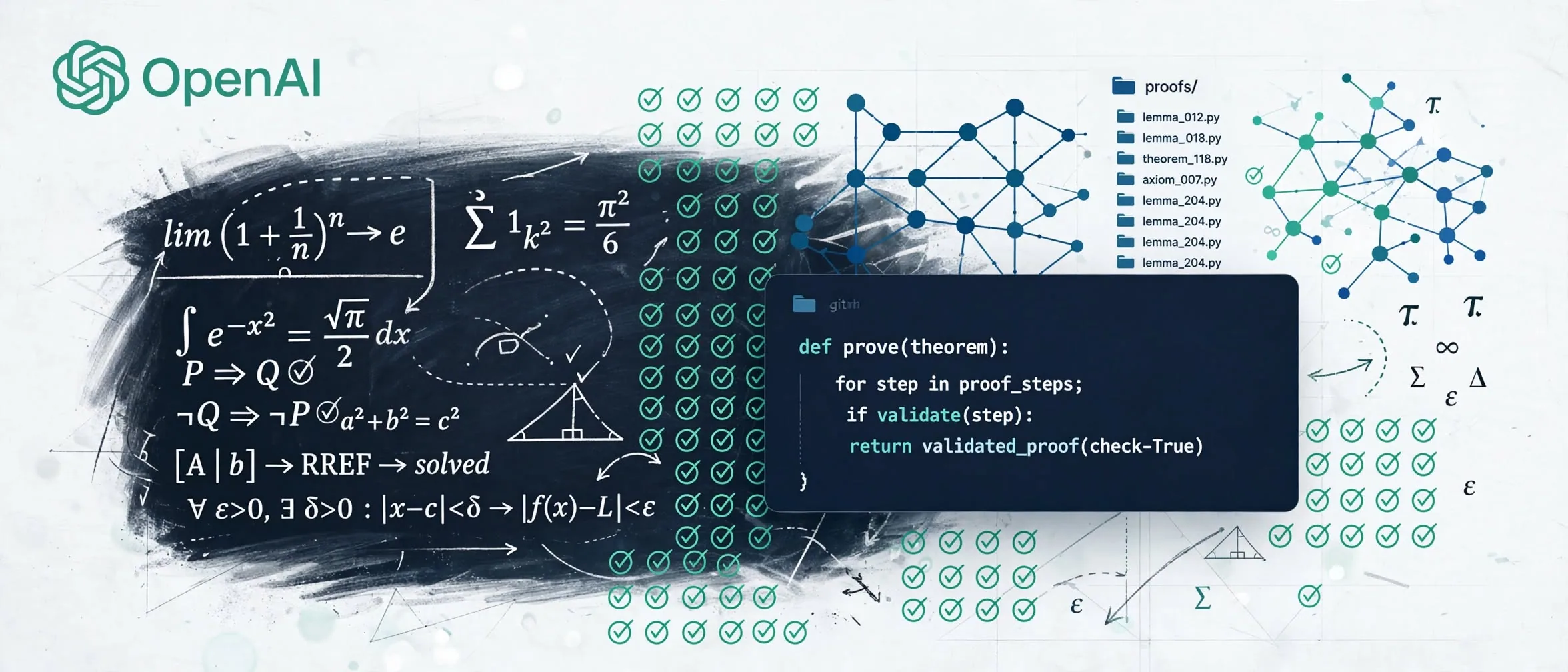
OpenAI has released 372 mathematical results generated by an internal frontier model, hosted directly on GitHub instead of submitting them to traditional peer-reviewed journals. According to the company, nearly every result came from a single prompt to a single AI agent, consuming an average of about three hours of ChatGPT Pro Thinking compute per proof.
How does machine verification solve the review bottleneck?
To handle the sheer volume of AI-generated proofs, OpenAI relies on Lean, a programming language designed for machine-checkable mathematical proofs. Because manual academic review cannot keep pace with mass-produced results, formal verification shifts the burden from human reading to automated logic checks. However, mathematicians point out that while Lean confirms logical correctness, it cannot judge whether a result holds genuine mathematical relevance.
What changes for quantitative professionals this week?
For data scientists and software engineers working with complex algorithms, this release signals a shift from using AI for basic code generation to automating advanced quantitative research. Generating a complex proof in roughly three hours means routine optimization tasks and algorithmic testing can now be offloaded directly to reasoning models. At the same time, the academic pushback—highlighted by 25 Fields Medal winners warning that mass-producing true statements risks destroying deep conceptual understanding—sets a clear boundary for how much developers should rely blindly on automated outputs.
Sources
Frequently asked questions
- How long does each AI math proof take to generate?
- According to OpenAI, each result consumed an average of about three hours of ChatGPT Pro Thinking compute, mostly derived from a single prompt to a single agent.
- How are these AI proofs verified without human academic peer review?
- OpenAI uses Lean, a programming language built specifically for machine-checkable mathematical proofs, allowing automated systems to verify logical correctness.
- Why is the mathematical community concerned about this release?
- Fields Medal winners argue that mass-producing mathematical truths focuses solely on problem-solving proxies rather than deep conceptual understanding and human insight.
Comments
0 commentsDeixe seu comentário
Be the first to comment.
Continue Lendo

Mistral Large 4: Infrastructure and Security Trade-Offs
Mistral Large 4 introduces a 1-trillion parameter model trained on 4,000 GPUs, targeting cybersecurity workloads that closed models block.

Cohere North 2: Enterprise AI Control Room
Cohere launched North 2, an enterprise control center for multi-step AI agents with model-agnostic support and on-premises deployment.
Reka Rho-1: Omnimodal AI Processes Text, Video, and Robots in One Network
Reka AI introduces Rho-1, a 19-billion-parameter omnimodal model combining text, video, and robot control in a single context window.