GPT-6 Luna and Claude Opus 5.5: Pricing and Limits
Alex da Cruz
Alex da Cruz is a full-stack developer based in São Paulo, Brazil. He works with React, TypeScript and automation, and uses AI daily to solve real problems in code and operations — not as a demo. He has run an e-commerce operation end to end, and now builds and maintains the automation pipeline behind this blog. He writes about what he actually tests.
According to simonwillison.net, OpenAI and Anthropic launched major model updates accompanied by aggressive price cuts, shifting the cost dynamics for developers building agentic workflows.
How much do GPT-6 Luna and Claude Opus 5.5 cost?
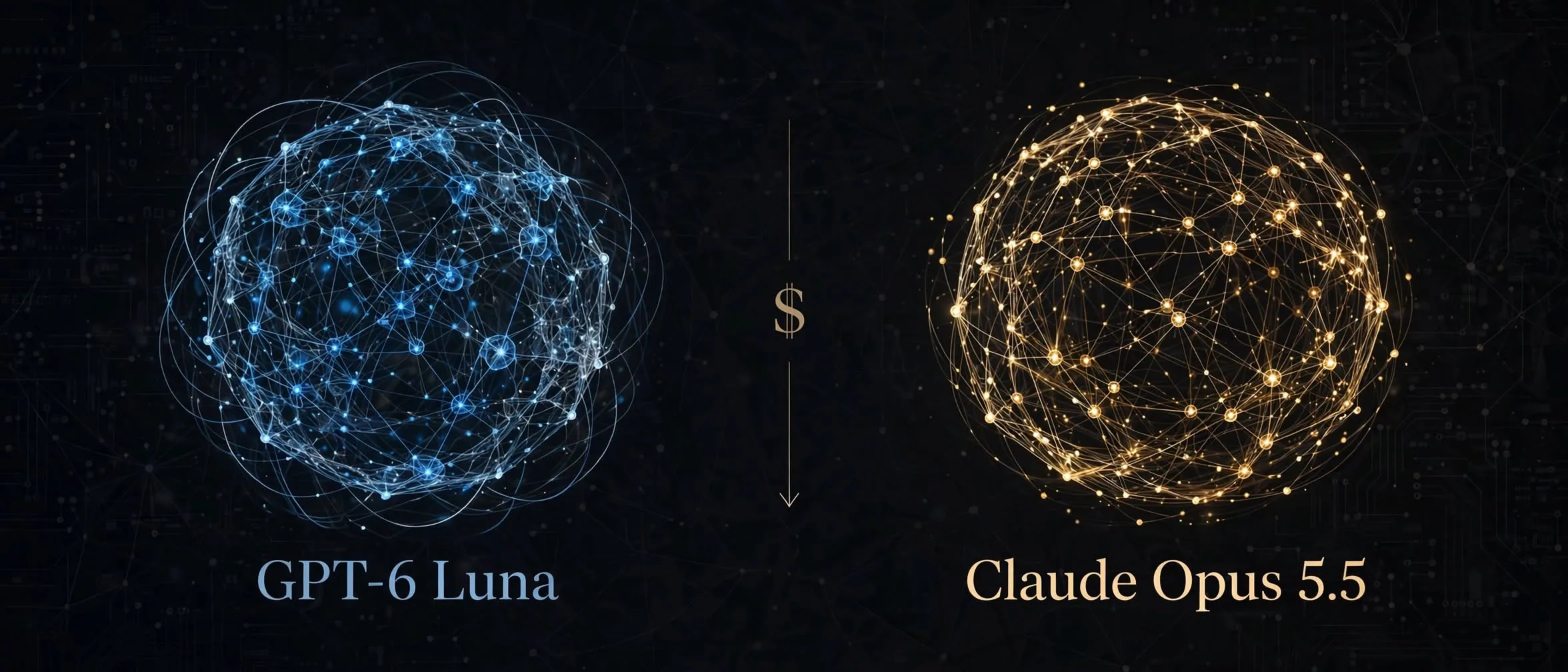
GPT-6 Luna drops input pricing to $0.10 per million tokens and output to $0.50, which is half the cost of its predecessor GPT-5.6 Luna. Meanwhile, Claude Opus 5.5 reduces input costs to $4 per million and output to $20, while cache read prices drop by 60%, heavily benefiting long agentic sessions.
What happens when Claude Opus 5.5 uses max reasoning?
Testing by Simon Willison showed that Claude Opus 5.5 on maximum reasoning effort hits its 128,000 output token limit exclusively on internal thinking before generating any response. Each failure wastes nearly 20 minutes and costs $2.56, proving that max reasoning can be practically useless for specific generation tasks.
What is the practical impact for development workflows?
Lower baseline pricing for models like GPT-6 Luna makes high-volume automation economically viable for smaller operations. Developers must monitor reasoning limits closely to avoid unexpected charges and stalled executions when running complex coding agents.
Sources
- Claude Opus 5.5, GPT-6 Sol, GPT-6 Luna, and a new price war — simonwillison.net
Frequently asked questions
- What is the price of GPT-6 Luna?
- GPT-6 Luna costs $0.10 per million input tokens, $0.01 for cached input, and $0.50 per million output tokens, making it one of OpenAI's cheapest models.
- Why does Claude Opus 5.5 fail on max reasoning?
- Opus 5.5 can exceed its 128,000 output token limit purely on internal chain-of-thought processing before producing any final output, wasting time and money.
Comments
0 comments
Be the first to comment.
Continue Lendo
OpenAI and Anthropic Cut AI Costs
OpenAI and Anthropic's new models slash API token costs by up to 50%, changing the economics of enterprise AI deployments.

Rabbit OS3: AI agent now runs on Windows, Mac, and Linux
Rabbit's OS3 brings its AI agent to Windows, Mac, and Linux, eliminating the need for the R1 hardware device.
OpenAI GPT-6 Sol and Luna: What Cuts API Costs in Half
OpenAI launched GPT-6 Sol and Luna, cutting API costs in half and separating complex coding tasks from high-volume clerical automation.